The Hidden Cost of Hosting a World Cup
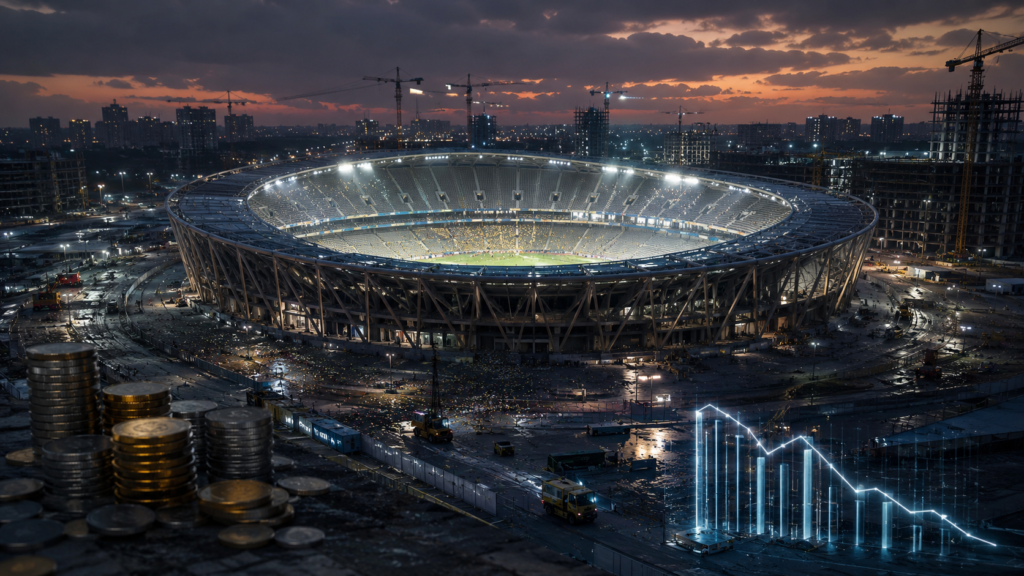
Winning a World Cup hosting bid feels like a triumph. The announcement comes with fireworks, delegation embraces, and promises of economic transformation. What follows is usually more complicated and far more expensive than any government minister standing at a podium in Zurich ever mentions out loud.
The pattern is consistent enough now that it’s hard to call it surprising.
The Numbers That Get Quoted vs. The Numbers That Matter
Every bid document includes projected tourism revenue, GDP uplift estimates, and long-term infrastructure benefits. These numbers are almost always optimistic to the point of fiction. Brazil 2014 cost somewhere between $15 billion and $20 billion depending on how you count it. The original budget was $3 billion. Qatar 2022 spent an estimated $220 billion across the whole project, though FIFA’s direct tournament costs were a fraction of that.
Russia 2018 built or renovated twelve stadiums. Several of those venues now sit in cities where the local clubs regularly draw crowds of a few thousand. Saransk’s Mordovia Arena, built for roughly $300 million, hosts a club that was relegated from the Russian top flight. The maintenance costs don’t stop because the cameras are gone.
Football content platforms have been covering this topic with increasing depth. https://kult-casino.com/ is one site tracking the business side of international football, and the economic aftermath of major tournaments has become one of the more discussed areas among engaged readers across the Nordic region.
The White Elephant Problem
It has a name for a reason. Stadiums built specifically to meet FIFA capacity requirements often don’t match the actual football culture of the host city. Manaus in Brazil got a 44,000-seat stadium for the 2014 World Cup. The local club, Nacional, plays in front of a few hundred people on a normal weekend. The venue cost roughly $270 million to build and the state government has been trying to figure out what to do with it ever since.
South Africa 2010 faced similar issues. Cape Town Stadium is genuinely beautiful and still largely unused for meaningful sport. The city explored converting it into a hotel at one point. These aren’t isolated failures. They’re what happens when tournament requirements outpace local football infrastructure.
The 2026 World Cup, spread across the US, Canada, and Mexico, sidesteps some of this by using existing NFL and MLS venues. That’s a smarter model. But it also means the tournament feels less like a national moment and more like a logistics exercise across three different countries with different football cultures.
What Hosting Actually Delivers
Tourism numbers rarely match projections. During the 2014 World Cup, Brazil actually saw a decline in regular tourism because non-football visitors stayed away. Hotels, transport, and local services get priced for the tournament and priced out of normal use for the duration.
There are genuine benefits: improved transport links in some cases, upgraded airports, broader international visibility for cities that wouldn’t normally appear on a global stage. South Korea’s profile changed meaningfully after co-hosting in 2002. Germany 2006 is still cited positively in terms of national image and infrastructure legacy. These aren’t nothing.
But the honest version of the cost-benefit analysis looks different from what gets presented at the bid stage. The economic models assume best-case scenarios on visitor numbers, media exposure conversion, and long-term investment attraction. Real outcomes are messier.
The 2034 Question
Saudi Arabia hosting in 2034 brings the economics back into sharp focus. The scale of planned construction (new stadiums, new cities, transport networks) makes even Qatar look modest. The human cost of that construction, as documented by labour rights organisations throughout Qatar’s build-up, is a separate and serious issue that sits alongside the financial one.
For countries considering future bids, and there are always countries considering future bids, the honest question is whether the return justifies the commitment. For smaller nations with limited infrastructure and tight public finances, the answer is probably no. For states where the project serves a different purpose than straightforward economic return, the calculation works differently.
That’s where football and geopolitics become genuinely difficult to separate.
Mircari Quotes And Sayings
 Blue Wall Paint Trends and Tips: Choosing the Perfect Wall Paint
 How A San Antonio Injury Lawyer Can Help You After An Accident
 Common Car Wreck Injuries
 How to Make Your Cornhole Games More Fun with Themed Bags
 Alexander Ostrovskiy: 10 Glute Exercises You’re Not Doing (But Should Be)
 Can video games replace traditional teaching methods?
 Top 5 Tension Fabric Display Suppliers in Singapore
 Syna World Shorts Set – Summer Style Redefined