Road Trips in the Digital Age: What We’ve Lost—and Gained—Behind the Wheel

There was a time when a road trip meant unfolding a paper map across the bonnet, arguing over directions, and discovering places by accident rather than algorithm. Today, the experience is very different. With smartphones mounted neatly beside the steering wheel and routes optimised in real time, driving has become more efficient—but arguably less mysterious.
As technology reshapes how we move, the road trip has evolved from a loosely planned adventure into something more structured, more connected, and, in some ways, more curated. But while some elements have been lost, others have emerged in their place, reflecting broader changes in automotive culture and how drivers relate to their vehicles.
The End of Getting Lost
Perhaps the most obvious shift is the disappearance of navigational uncertainty. GPS systems and apps have effectively eliminated the need to “figure things out” on the road. Detours are no longer accidental; they’re calculated. Traffic jams are anticipated, not stumbled upon.
This has undoubtedly improved convenience. Journeys are faster, safer, and less stressful. Yet something intangible has faded. The sense of discovery—finding a hidden village, a roadside café, or an unexpected viewpoint—is now often replaced by pre-selected stops with five-star ratings.
Drivers today are less explorers and more informed travellers. Whether that’s progress or loss depends on perspective.
Cars as Digital Spaces
Modern vehicles are no longer just modes of transport; they’re extensions of our digital lives. Infotainment systems sync with phones, playlists are streamed rather than curated in advance, and voice assistants respond to commands mid-journey.
This connectivity has changed the atmosphere inside the car. Conversations compete with notifications, and silence is easily filled. For some, this enhances the experience—long drives feel shorter when entertainment is on demand. For others, it detracts from the simplicity that once defined road travel.
The car has shifted from being a retreat to being another connected environment, not unlike the home or office.
The Rise of Curated Journeys
Social media has had a subtle but powerful influence on road trips. Destinations are often chosen not just for their intrinsic appeal, but for how they will appear online. Scenic routes, coastal drives, and mountain passes are now as much about visual storytelling as they are about the drive itself.
Platforms like Instagram and TikTok have turned certain roads into cultural landmarks. The journey is documented in real time, shared, and consumed by others. In this sense, road trips have become performative—less about private experience and more about public narrative.
This doesn’t necessarily diminish their value, but it does change their nature. The spontaneous becomes planned, and the personal becomes shareable.
Personalisation Behind the Wheel
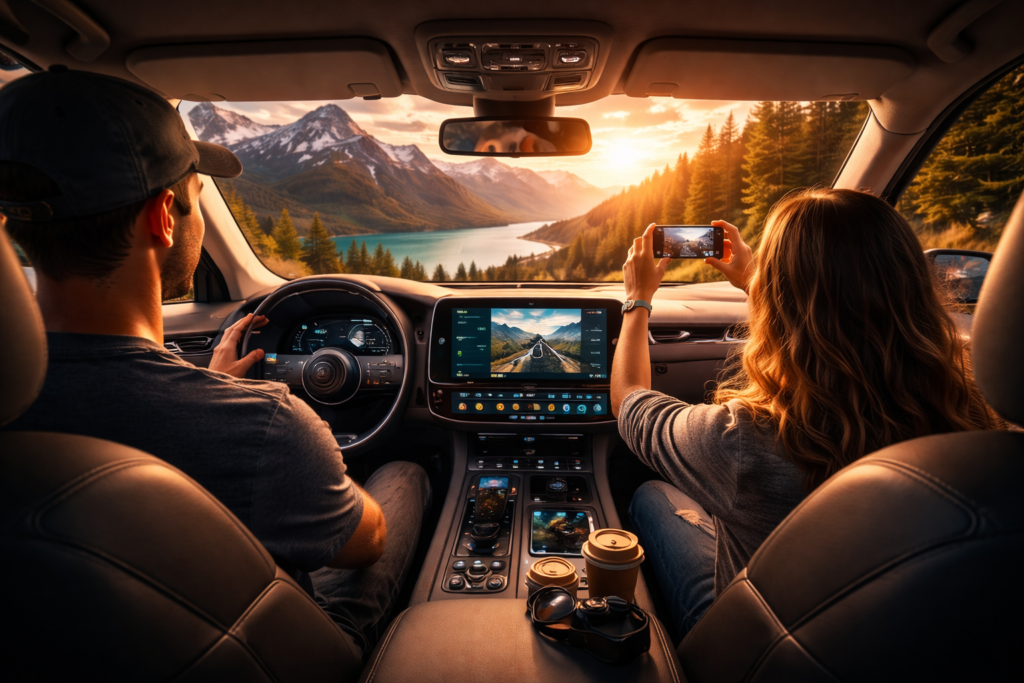
As cars become more technologically advanced, drivers are finding new ways to express individuality. From interior lighting schemes to digital dashboards, personalisation is increasingly embedded within the vehicle itself.
Externally, the desire for identity remains just as strong. Subtle modifications, aesthetic tweaks, and distinctive details all play a role in how drivers present themselves on the road. Even small elements can carry meaning, reflecting personality, taste, or status.
It’s in this broader context that companies like Number 1 Plates have seen growing interest—not as a focal point of the driving experience, but as part of a wider movement towards making vehicles feel more personal. The modern driver isn’t just concerned with getting from A to B; they’re thinking about how that journey represents them.
Efficiency vs Experience
Digital tools have made road travel more efficient than ever. Fuel stops can be planned with precision, routes adjusted instantly, and destinations booked en route. There’s less friction in the process, fewer unknowns.
But efficiency doesn’t always equate to enjoyment. The friction of older road trips—the need to adapt, improvise, and occasionally get things wrong—was often where the most memorable moments emerged.
Today’s drivers face a trade-off. The journey is smoother, but perhaps less memorable in its unpredictability. Whether that matters depends on what individuals seek from the experience.
The Changing Meaning of the Journey
The idea of the road trip has always been tied to freedom. In the past, that freedom came from disconnection—from leaving routines behind and embracing the unknown. Now, it often comes from control: the ability to tailor every aspect of the journey to personal preferences.
This shift reflects a broader cultural change. We are more informed, more connected, and more intentional in how we travel. The open road still represents possibility, but it’s a different kind of possibility—one shaped by data, technology, and personalisation.
Conclusion
Road trips in the digital age are neither better nor worse than those of the past—they’re simply different. The tools we use have transformed how we navigate, experience, and remember our journeys.
What we’ve gained is clarity, convenience, and connection. What we’ve lost, to some extent, is spontaneity and the thrill of the unknown.
Yet the essence of the road trip endures. It’s still about movement, exploration, and the relationship between driver and machine. The difference is that today’s journeys are as much about identity and experience as they are about distance.
And perhaps that’s the defining feature of modern driving: not just where we go, but how we choose to get there—and what that says about us along the way.
Mircari Quotes And Sayings
 Blue Wall Paint Trends and Tips: Choosing the Perfect Wall Paint
 How A San Antonio Injury Lawyer Can Help You After An Accident
 Common Car Wreck Injuries
 How to Make Your Cornhole Games More Fun with Themed Bags
 Alexander Ostrovskiy: 10 Glute Exercises You’re Not Doing (But Should Be)
 Can video games replace traditional teaching methods?
 Top 5 Tension Fabric Display Suppliers in Singapore
 How to Focus on Studying for Successful Admission