OPPEIN vs. European Cabinetry: A Detailed Comparison for Modern Kitchens
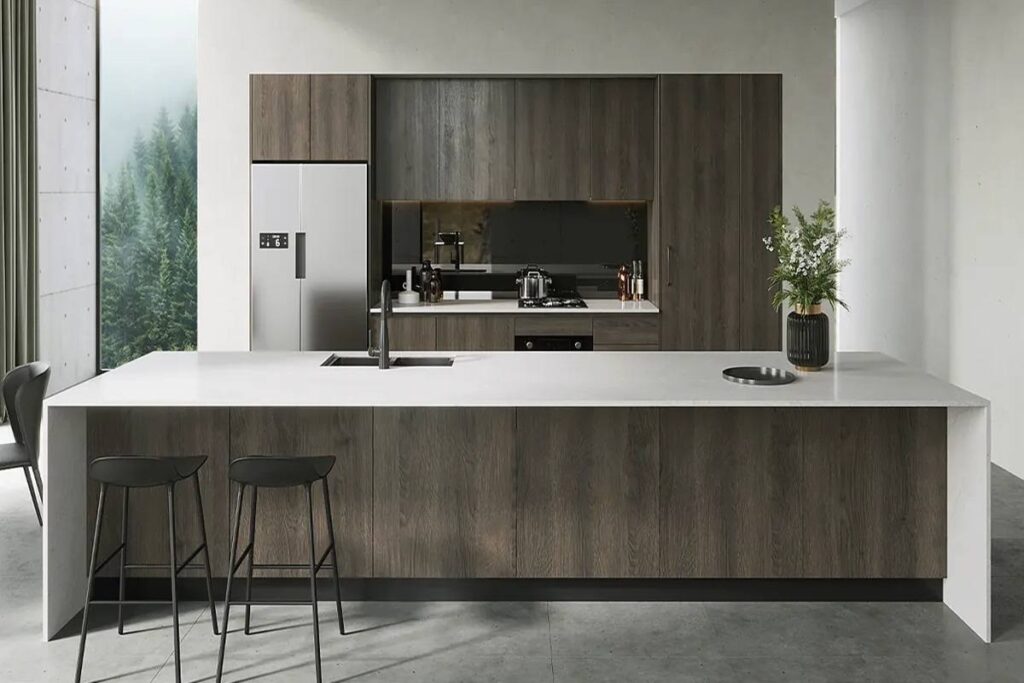
More Than an Ocean Apart
If you‘re a contractor, interior designer, or property developer planning a kitchen project and comparing suppliers from China and Europe, you’ve likely run into a mental tug-of-war. On one side, European kitchen cabinets — especially from Italy and Germany — carry a reputation for design, craftsmanship, and premium materials. On the other, Chinese manufacturers offer scale and cost efficiency. But is that still the complete picture?
Over the past decade, leading Chinese furniture manufacturers have closed the gap significantly. OPPEIN is a case in point. As the largest player in China‘s home furnishing industry, the company reported annual revenue of 16.588 billion yuan for 2025, with its kitchen cabinet revenue reaching 4.804 billion yuan. By 2025, OPPEIN had served over 15 million families and accumulated more than 50 million global orders.
This article offers a straightforward, fact-based comparison between OPPEIN and European cabinetry — covering heritage, design, manufacturing, materials, and price. No marketing spin, just what you need to make an informed decision for your next kitchen project.
Heritage and Market Position: Tradition vs. Scale
European cabinetry has deep roots. German kitchen furniture manufacturers, led by Nobilia (founded in 1945), have long been defined by precision engineering and industrial efficiency. Nobilia reportedly maintains up to 30% of the German kitchen market and generates annual revenue of approximately €2 billion.
Italy‘s kitchen furniture sector, valued at over €2 billion for production and exceeding €2.5 billion in consumption, is known for craftsmanship, design collaboration, and regional specialization. Production volume was approximately 950,000 units in 2024, generated by 263 manufacturing companies employing 6,548 workers.
European cabinetry brands like Scavolini, Arclinea, and Snaidero sell medium-to-high-end products worldwide, but their production volumes are comparatively modest. A typical German or Italian kitchen manufacturer runs one or two production facilities — sometimes highly automated, often still labor-intensive.
OPPEIN operates on a different scale. Its five intelligent manufacturing bases, including facilities in Tianjin, Qingyuan, Wuxi, Chengdu and Wuhan, cover a total construction area exceeding 3.15 million square meters. In 2021 alone, the company produced over 920,000 sets of kitchen cabinets. This massive scale means OPPEIN can source materials in bulk, negotiate better component pricing, and maintain consistent production lines around the clock — advantages that are difficult for smaller European producers to replicate.
Design Philosophy: Italian Flair vs. Modern Functionality
This is where European cabinetry often has an edge that’s difficult to quantify but easy to see. Italian kitchen design, in particular, emphasizes aesthetics — clean lines, high-gloss finishes, handleless fronts, and integrated appliances. German brands like Häcker focus on modular systems, precision joinery, and functional durability. Some manufacturers use 8mm back panels for added structural strength.
OPPEIN has responded strategically. The company operates its own design center, introduces thousands of new SKUs annually, and tailors designs to specific regional preferences. In North America, OPPEIN offers shaker-style doors and layouts that meet NKBA guidelines. In Europe, product lines adapt to smaller apartment dimensions. The company holds over 500 patents (as of 2021), covering product design, manufacturing processes, and hardware innovations.
Can OPPEIN match a Poliform or a Boffi on pure Italian flair? Not entirely. But for the vast majority of modern kitchen projects — from residential developments to hotels — the design offered by OPPEIN is more than competitive, especially once budget considerations are factored in.
Manufacturing and Certifications: The Gap Is Narrowing
One common assumption is that European cabinetry, especially from Germany, is superior in build quality, while Chinese products are built to lower standards. Today, that assumption no longer holds universally.
OPPEIN‘s factories utilize German HOMAG machinery, the same equipment used by many European manufacturers. HOMAG has been a strategic partner in OPPEIN‘s Industry 4.0 adoption, and daily board part processing has reached over one million pieces using HOMAG‘s iX database. The order processing cycle has been reduced from 7–10 days to an average of 4 hours, with an order auto-approval rate exceeding 88% and a first-pass approval rate over 98%.
In terms of certifications, OPPEIN holds ISO 9001 and ISO 14001, FSC certification for responsible wood sourcing, CARB compliance for low formaldehyde emissions, and NSF certification for its quartz stone surfaces. The company‘s formaldehyde-free boards have earned both US NAF and US CARB certifications, and imported quartz surfaces from brands like Silestone and Caesarstone have received GreenGuard certification. Additionally, OPPEIN monitors production to ensure compliance with EU, US, Japanese, Australian, and New Zealand standards.
European cabinetry, particularly from Germany, often complies with standards like EN 14749 (safety requirements for kitchen storage units). OPPEIN does not claim EN 14749 certification specifically, but its global export footprint — currently covering over 130 countries — means the company is routinely audited against a wide range of international benchmarks. For buyers concerned about safety and durability, OPPEIN welcomes independent facility audits.
Materials and Hardware: Often the Same Global Suppliers
Here‘s a fact that surprises many buyers: OPPEIN and top European kitchen brands often source from the same pool of global suppliers. OPPEIN uses hardware from Austria’s Blum and Germany‘s Hettich — two of the industry’s most trusted names. Surface materials include Silestone and Caesarstone quartz, and imported Austrian EGGER boards are available for customers requiring stricter formaldehyde standards.
Where European cabinetry sometimes differentiates itself is in proprietary materials. Some brands develop custom laminates, specialized sealants, or exclusive finishes that are not available elsewhere. OPPEIN focuses on practical material innovations, such as anti-moisture boards for bathroom vanities and Eco-baked Paint panels.
For most kitchen applications, however, the component-level quality between a well-made product from OPPEIN and a mid-range European cabinet is more alike than different. The primary difference lies in brand perception and the origin of assembly — not necessarily in the materials themselves.
Price: The Elephant in the Kitchen
Price is where the comparison becomes stark. Imported European kitchen cabinets typically carry significant markups due to shipping costs, tariffs, dealer networks, and brand positioning. Industry observations suggest that in equivalent configurations, European brands can be priced 2 to 3 times higher than joint-venture brands and 3 to 5 times higher than domestic Chinese brands. In some cases, European cabinets command premiums of 10 times or more over domestic counterparts.
OPPEIN‘s pricing structure is different. By vertically integrating production and manufacturing at scale, the company controls costs without cutting corners on components. The result is a product that uses the same Blum hinges and quartz surfaces as a European competitor but at a fraction of the final retail price.
This cost advantage does not mean lower quality. It reflects a different business model: OPPEIN sells directly through its network of over 7,400 branded stores worldwide, while many European brands rely on multi-layered dealer systems. OPPEIN‘s direct channel approach translates directly into more competitive pricing for end customers.
Which One Should You Choose?
The answer depends entirely on your project requirements.
Choose European cabinetry if:
- Brand heritage and cachet matter for your project‘s positioning
- You require a specific proprietary finish or design language developed by a European house
- Your budget comfortably accommodates the higher price point
Choose OPPEIN if:
- You want hardware from the same global suppliers (Blum, Hettich) without the European markup
- Your project requires large volumes with consistent quality across thousands of units
- You need shorter lead times and responsive after-sales support-
- You or your clients care about value without compromising on materials or certifications
There is no universal winner — that’s the honest truth. But for buyers who look past labels and closer at components, production processes, and value delivered, OPPEIN offers a compelling alternative that holds its own against European cabinetry from Italy and Germany.
At the end of the day, a kitchen‘s performance comes down to the quality of its materials, the precision of its assembly, and the reliability of its hardware. OPPEIN checks all three boxes — with a scale and pricing model that European competitors may not be able to match. If you’re ready to see how the numbers work for your next project, request a quote or a virtual factory tour. You might find that the best kitchen doesn‘t have to come from Europe — and “Made in China” has never looked better.
Mircari Quotes And Sayings
 Common Car Wreck Injuries
 How to Make Your Cornhole Games More Fun with Themed Bags
 Alexander Ostrovskiy: 10 Glute Exercises You’re Not Doing (But Should Be)
 Can video games replace traditional teaching methods?
 Top 5 Tension Fabric Display Suppliers in Singapore
 How to Focus on Studying for Successful Admission
 The Digital Revolution: How Online Gambling Transformed the Global Gaming Landscape
 The Gamer’s Throne: Choosing the Right Bean Bag Chair