The Hidden Geography Problem That Could Be Killing Your Website’s AI Visibility
If you run a website, you probably spend time thinking about content quality, page speed, and user experience. But here’s something you’ve likely never considered: where the robots that crawl your website actually live.
It might sound strange, but the physical location of AI crawlers can make or break your site’s visibility in AI search engines like ChatGPT, Perplexity, and others. A recent analysis of nearly 500 crawler IP ranges revealed a shocking pattern that every website owner needs to understand.
The Invisible Divide: Search Engines vs. AI Crawlers
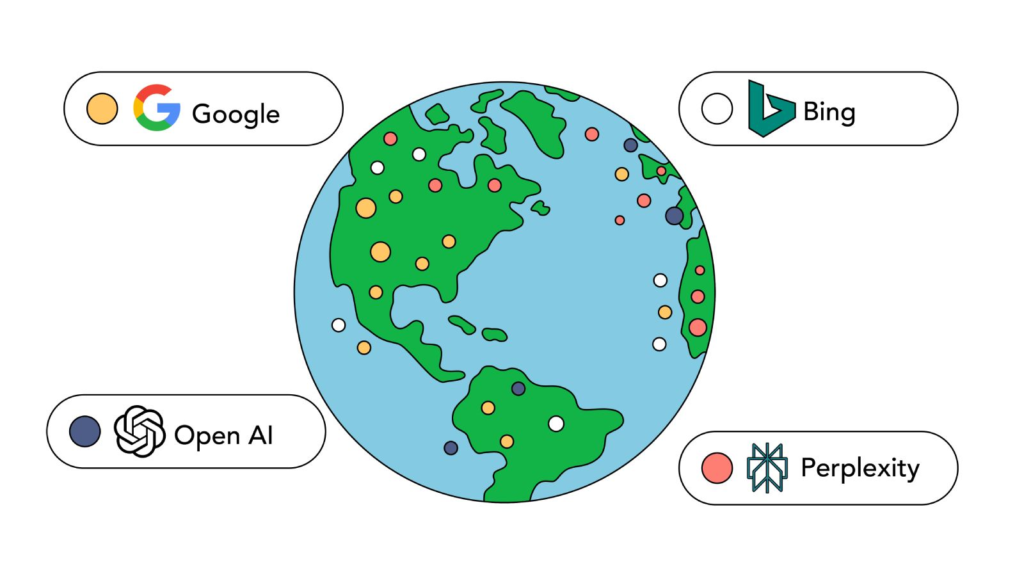
When researchers mapped out the geographic locations of major search and AI crawlers, they discovered something surprising. Traditional search engines like Google and Bing have crawler infrastructure spread across the globe. Googlebot operates from 22 countries, with servers in Montreal, Tokyo, Frankfurt, Singapore, and dozens of other cities worldwide.
But AI crawlers? They’re all in one place: the United States.
OpenAI’s GPTBot operates exclusively from three US cities: Phoenix, Atlanta, and Des Moines. Perplexity’s entire crawler fleet runs from a single location in Virginia. Every autonomous AI crawler analyzed in the study was US-based.
Why This Geographic Concentration Matters
You might be wondering: why does it matter where a crawler operates from? The answer comes down to physics and time limits.
When a bot in Phoenix tries to crawl a website hosted in Tokyo or Frankfurt, it faces 150-200 milliseconds of network delay before it even receives any data. That’s pure physics – the speed of light through fiber optic cables across oceans.
This wouldn’t be such a problem if AI bots had unlimited time to wait for responses. But they don’t. ChatGPT’s crawler times out after just 5 seconds. Gemini’s bot gives up after 4 seconds. When you start with 200 milliseconds of network latency just for the round trip, that timeout window closes fast.
Here’s what this means in practice: if your website is hosted outside the United States and takes 2 seconds to generate a page, a US-based crawler might see it take 2.2 seconds due to network distance alone. For a slower site that takes 3 seconds to respond, the crawler might experience a 3.2-second load time. On edge cases, this can mean the difference between your content being indexed or completely missed.
The Business Impact
The implications extend beyond just technical metrics. If your website serves customers in Europe, Asia, or anywhere outside the US, but all the AI crawlers accessing your site come from American data centers, you’re facing a built-in disadvantage.
A website hosted in Sydney serving Australian customers will load quickly for human visitors. But GPTBot crawling from Phoenix sees a fundamentally different performance profile. The same applies to European sites, Asian sites, or anywhere with geographic distance from US data centers.
This creates an unintended bias in AI search results. US-hosted websites have a structural advantage in AI visibility simply because of proximity to crawler infrastructure. For businesses trying to compete globally, this geography gap is a hidden obstacle.
What Website Owners Can Do
Understanding this problem is the first step. Here are practical actions you can take:
Check Your Geographic Blocking Rules
Many websites use country-based traffic restrictions. Medical sites regulated by US state law often block international traffic. European sites sometimes block US visitors to avoid GDPR compliance requirements. If your site has any geographic blocking in place, verify that US IP ranges aren’t restricted.
The irony is real: a European business blocking US traffic to avoid GDPR might also be blocking every AI crawler that could make their content discoverable in AI search engines.
Optimize for Speed
Since AI bots impose hard timeouts and network distance adds unavoidable latency, every millisecond of server response time matters more than ever. Standard web optimization advice applies, but with higher stakes.
Using pre-rendering solutions can make a significant difference. Tools like EdgeComet handle the heavy lifting of rendering JavaScript-heavy sites at the edge, serving bots fully rendered HTML instantly – critical when dealing with cross-continental latency and strict timeout windows.
Test Your AI Visibility Regularly
Don’t assume AI crawlers can see your content. Periodically ask ChatGPT or Perplexity to fetch specific information from key pages on your site. If the bot cannot retrieve the content or returns incorrect data, you’ve identified a visibility problem.
This simple test catches issues before they impact your traffic. The cause might be geographic blocking, timeout from distance, or content that bots can’t process. Whatever the reason, knowing about it lets you fix it.
The JavaScript Challenge
There’s another layer to this problem that makes geography even more critical: AI crawlers don’t execute JavaScript.
Unlike Google and Bing, which render JavaScript-heavy sites to extract content, current AI crawlers fetch raw HTML and stop. If your content depends on client-side rendering – React applications, Vue.js sites, Angular frameworks – that content is invisible to AI bots regardless of where they operate from.
For sites that do serve complete HTML, the geographic problem compounds the JavaScript issue. A server in Asia-Pacific responding to a US-based bot already starts with network disadvantage. If that server also needs time to process and render content, the timeout risk increases substantially.
Pre-rendering addresses both problems simultaneously. By serving bots pre-rendered HTML at the edge, you eliminate JavaScript execution requirements and minimize the impact of geographic distance. Solutions like EdgeComet specifically solve this dual challenge without requiring changes to your frontend code.
Looking Forward
The concentration of AI crawler infrastructure in the United States appears to be a temporary state driven by the current phase of AI development. As these services scale globally, we’ll likely see more distributed crawler networks similar to traditional search engines.
Until then, website owners need to account for this geographic reality in their optimization strategies. The good news is that the same practices that help with AI crawler access – fast response times, pre-rendered content, and proper geographic configuration – also improve the experience for human visitors and traditional search engines.
The Bottom Line
AI search is reshaping how people discover content online. But if your website is hosted outside the US and you haven’t optimized for the realities of US-based crawler infrastructure, you might be invisible to these AI systems without realizing it.
The solution isn’t necessarily moving your entire site to US hosting. The solution is understanding where the bots live, how network distance affects their ability to crawl your content, and taking specific technical steps to bridge that geographic gap.
In the emerging world of AI search, geography matters more than most people realize. Now you know why – and what to do about it.
________________________________________
About the technology: The data referenced in this article comes from analysis of 484 IP subnets covering approximately 19,000 crawler IP addresses across Google, Bing, OpenAI, and Perplexity networks. ClaudeBot was excluded as Anthropic does not publish IP ranges.
Mircari Quotes And Sayings
 How to Focus on Studying for Successful Admission
 Top 5 Tension Fabric Display Suppliers in Singapore
 Can video games replace traditional teaching methods?
 Alexander Ostrovskiy: 10 Glute Exercises You’re Not Doing (But Should Be)
 How to Make Your Cornhole Games More Fun with Themed Bags
 Common Car Wreck Injuries
 How A San Antonio Injury Lawyer Can Help You After An Accident
 Blue Wall Paint Trends and Tips: Choosing the Perfect Wall Paint