Precision Without Bottlenecks: How High-Tech Manufacturers Scale Without Sacrificing Control
“Move faster,” they say. It’s the constant drumbeat in every high-tech facility from Silicon Valley to Shenzhen. But here’s the cold, hard truth we often ignore over our morning coffee: speed without control is just a fast way to fail.
In the race to hit aggressive throughput targets, accuracy is often treated like a luxury, something we’ll “tighten up” once the rush is over. But in an era of micro-components and razor-thin margins, that’s a dangerous gamble. You aren’t just managing parts; you’re managing momentum.
I’ve seen brilliant production lines grind to a screeching halt because someone prioritized a “quick tally” over a precise count. It’s the ultimate irony of modern manufacturing: the very shortcuts we take to save time are usually the ones that steal it back with interest.
This article isn’t about choosing between being fast or being right. It’s about why that “choice” is a myth. We’re going to dive into how the world’s most efficient manufacturers are balancing the scales, ensuring that precision acts as the fuel for throughput, not the brake.
Why speed alone is not real efficiency
In many factories, “speed” is measured by how fast a reel moves from the warehouse to the feeder. But if that reel contains a 5% count discrepancy, that initial speed is a total illusion. You haven’t gained time; you’ve simply deferred a crisis to a more expensive stage of production.
Real efficiency is about net yield, not raw velocity. When a high-speed line stops because of a “component out” error that wasn’t caught during the intake count, the cost per second of downtime dwarfs any time saved by rushing the initial verification.
Think of it as the “Rework Tax.” Every time an operator has to perform a manual recheck or pull a reel off a machine to verify stock, your operational flow is shattered. These micro-interruptions are the silent killers of throughput, often adding hours of “invisible labor” to a shift that looked fast on paper.
True efficiency means moving at a pace that maintains integrity. If your process creates downstream waste, like half-finished boards waiting for a missing resistor, your “high-speed” workflow is actually a bottleneck in disguise.
The false tradeoff between accuracy and throughput
For years, the manufacturing world has operated under a persistent myth: that you can have precision or you can have volume, but never both at the same time. This “accuracy tax” suggests that being careful is a slow, manual chore that drags down your hourly output.
In reality, this is a binary choice that no longer exists in high-tech environments. Modern automated verification has turned accuracy from a speed bump into a “pass-through” activity. When counting happens in real-time or at high speed during the intake phase, precision becomes a frictionless layer of the process rather than a standalone event.
Consider the difference in these two operational models:
- The Traditional Model: Fast, sloppy intake followed by three emergency “stop-the-line” re-counts per shift.
- The Precision Model: High-speed, accurate intake that allows the line to run at 100% capacity for the entire shift.
Which one actually produces more units? When you look at the Total Effective Equipment Productivity (TEEP), the precision-first approach wins every time. By investing seconds in verification at the start, you protect the hours of throughput that would otherwise be lost to “investigative downtime.”
Where bottlenecks really come from in micro component workflows
We often blame “old machines” or “slow operators” for production lags, but the true culprit is usually informational friction. In micro-manufacturing, a bottleneck is rarely a physical jam; it’s the moment an operator stops the line to ask, “Do we really have enough of these 0402 capacitors to finish the job?”
Uncertainty is the ultimate hidden slowdown. When inventory data is unreliable, your team defaults to defensive workflows recounting reels by hand or double-checking ERP entries before every run. These “safety checks” might feel like due diligence, but they are actually manual anchors dragging down your total output.
Consider these common hidden bottlenecks that kill momentum:
- The Verification Loop: Every time a reel is returned from the SMT line with a “guessed” quantity, it creates a ripple effect of doubt for the next shift.
- Search and Rescue: Hours are lost searching for “missing” components that were actually miscounted or misplaced during a rushed intake.
- Feeder Failures: Inconsistent component spacing or orientation, often missed by manual checks, leads to pick-and-place errors that force an entire line reset.
These disruptions are inconsistent, making them almost impossible to schedule around. Unlike a predictable machine maintenance cycle, data-driven bottlenecks happen at random, shattering your throughput and forcing your most skilled engineers to act as inventory detectives instead of production leaders.
How accurate counting supports smoother material flow
Precision is the “green light” that keeps your material flow moving without hesitation. When the input stage, the very moment a reel enters your facility, is verified with absolute accuracy, you eliminate the upstream ripples that usually turn into downstream tidal waves.
Think of accurate counting as a high-fidelity GPS for your production floor. If the data at the start of the journey is wrong, every “turn” the material takes through the warehouse, kitting, and staging is based on a flawed map. By locking in the count early, you ensure that every subsequent handoff is seamless and every replenishment trigger is perfectly timed.
This synchronization allows for a “Just-in-Time” (JIT) reality rather than just a JIT theory. You can narrow your safety stock buffers because you finally trust your numbers, freeing up capital and floor space. Smoother flow isn’t about moving parts faster; it’s about removing the stuttering pauses that happen when the physical reality of your inventory disagrees with your digital records.
Elmor’s role in precision-driven productivity
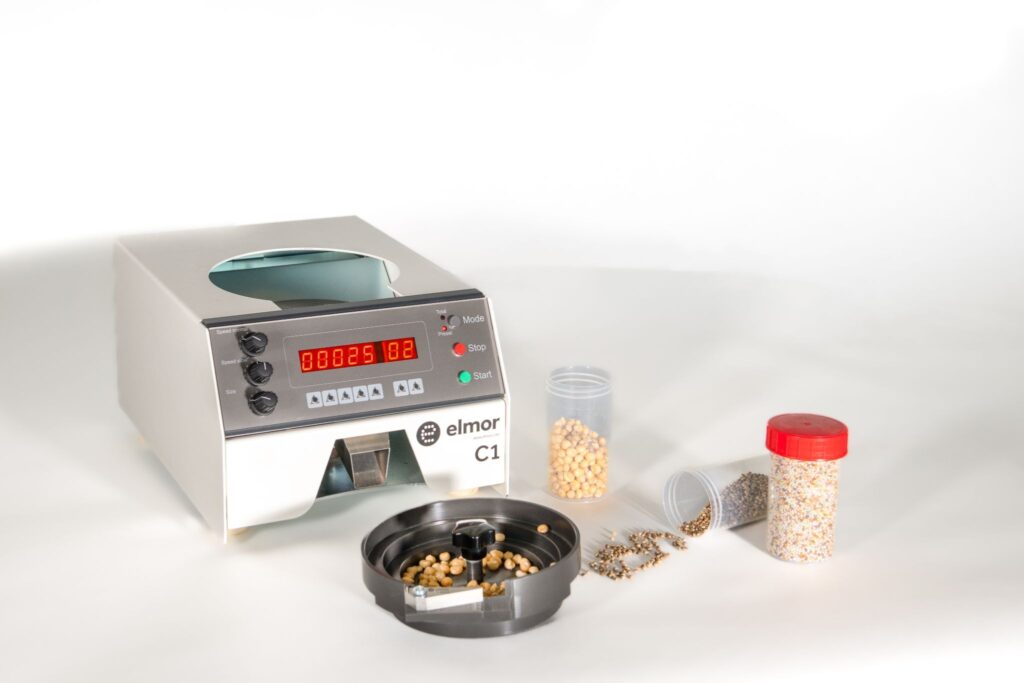
If the goal is to eliminate the gap between accuracy and speed, then the technology used must be faster than the problem it solves. Elmor bridges this gap by replacing the “guess-and-check” manual workflow with high-speed optical counting. Instead of a technician spending ten minutes trying to weight-count a reel of micro-resistors, the Elmor system does it in seconds with absolute certainty.
This technology doesn’t just count; it validates the integrity of your production line before the first board is even loaded. By using advanced sensors that detect parts with light rather than mass, Elmor removes the variables that typically cause bottlenecks, such as component size, weight variance, or static electricity.
The result is a workflow where precision is built-in, not bolted on. Manufacturers using Elmor report a “virtuous cycle” of productivity:
- Accelerated Intake: Reels move from the loading dock to the SMT line in a fraction of the time.
- Zero-Defect Inventory: “Phantom stock” disappears because every part is verified with 99.9% accuracy.
- Predictable Scheduling: Production managers can commit to tight deadlines because they finally trust their material availability.
By shifting the burden of accuracy from the human operator to a high-precision optical system, you aren’t just buying a counter, you are purchasing an insurance policy for your throughput. You are ensuring that your factory moves at the speed of light, backed by the certainty of data.
The days of treating inventory as a “back-office problem” are over. In the high-stakes world of micro-electronics and precision assembly, data integrity is the new currency. We are moving toward a future where the distinction between a “warehouse” and a “production line” disappears, replaced by a single, fluid ecosystem where every component is tracked and verified in real-time.
Choosing to ignore counting bottlenecks today is choosing to let your competitors define the pace of your industry. You don’t want to be the facility that loses a million-dollar contract because a five-cent resistor went missing in a rounding error. Precision isn’t just a technical metric; it is the foundation of your reputation.
As manufacturing becomes more automated, the human element should focus on strategy and growth, not on fighting “phantom inventory” fires. It’s time to stop letting micro-discrepancies steal your profit and start building a workflow that is as precise as the products you create.
Don’t wait for the next line stoppage to realize your counts are off. Every hour you operate with “estimated” inventory is a gamble with your throughput. Contact Elmor today to audit your current counting process and lock in the precision you need to scale your production without the bottlenecks. Secure your line’s future now.
Frequently Asked Questions
Why does manual counting create production bottlenecks?
Manual counting is inherently slow and prone to human error, especially with micro-components. It forces highly skilled operators to stop production to verify stock levels, creating “dead time” that destroys your line’s momentum and predictability.
How does precision counting increase total throughput?
Precision counting ensures that your digital inventory matches physical reality, eliminating the interruption cycle. When counts are 100% accurate, you avoid the emergency shutdowns and “re-kitting” delays that occur when a component shortage is discovered mid-run.
What is the difference between production speed and operational efficiency?
Speed is how fast a machine can run, but efficiency is the net yield of good parts over time. A fast machine that stops frequently for inventory checks or “phantom stock” errors is actually less efficient than a steady line supported by accurate material flow.
Can optical counters handle different component sizes without recalibration?
Yes. High-quality optical systems, like those from Elmor, use light sensors to detect parts individually regardless of their mass. This allows you to switch between different components instantly without the time-consuming recalibration required by traditional weight-based scales.
How does accuracy affect Just-in-Time (JIT) manufacturing?
JIT relies on trust. When your counting is precise, you can safely reduce your inventory buffers and “safety stock,” freeing up warehouse space and capital without increasing the risk of a line stoppage.
Mircari Quotes And Sayings
 Modern Loneliness and the Rise of Paid Companionship Services
 The Comfort Routine People Are Turning To This Year
 Best Indoor Seeds: High-Yield Indoor Strains for Every Grower
 Why Settle for Boring? Building Features That Make Life More Fun
 How to Make Your Cornhole Games More Fun with Themed Bags
 Common Car Wreck Injuries
 How A San Antonio Injury Lawyer Can Help You After An Accident
 Blue Wall Paint Trends and Tips: Choosing the Perfect Wall Paint