How Much Power Do You Need for Laser Cleaning?
Are you planning to buy a laser cleaning machine? Then you may also be wondering how to choose the right power. There are many kinds of machines on the market now, and the power options are also very different. In fact, a laser cleaning machine is not always better just because it has higher power. It still needs to be chosen based on the real working condition.
Before buying one, you need to know what you are going to clean. Is it rust, paint, oxide, oil stains, or paint on a wood surface? Is the workpiece made of steel, aluminum, or a part that is sensitive to heat? Do you want higher efficiency, or more stable cleaning results? All of these things can affect the power you should choose.
From years of market observation for HANTENCNC, fine cleaning and large-area industrial cleaning are really two different solutions. The first one cares more about control, heat effect, and surface protection. The second one cares more about speed, coverage area, and cleaning efficiency. So when choosing a laser cleaning machine, it is better to judge it under the real working condition.
This article will explain how to choose laser cleaning machine power in a clear way: what kind of work fits what kind of power, how to choose between pulsed and continuous laser, and what really affects cleaning efficiency. Hopefully it can help when you plan to buy a laser cleaning machine later.
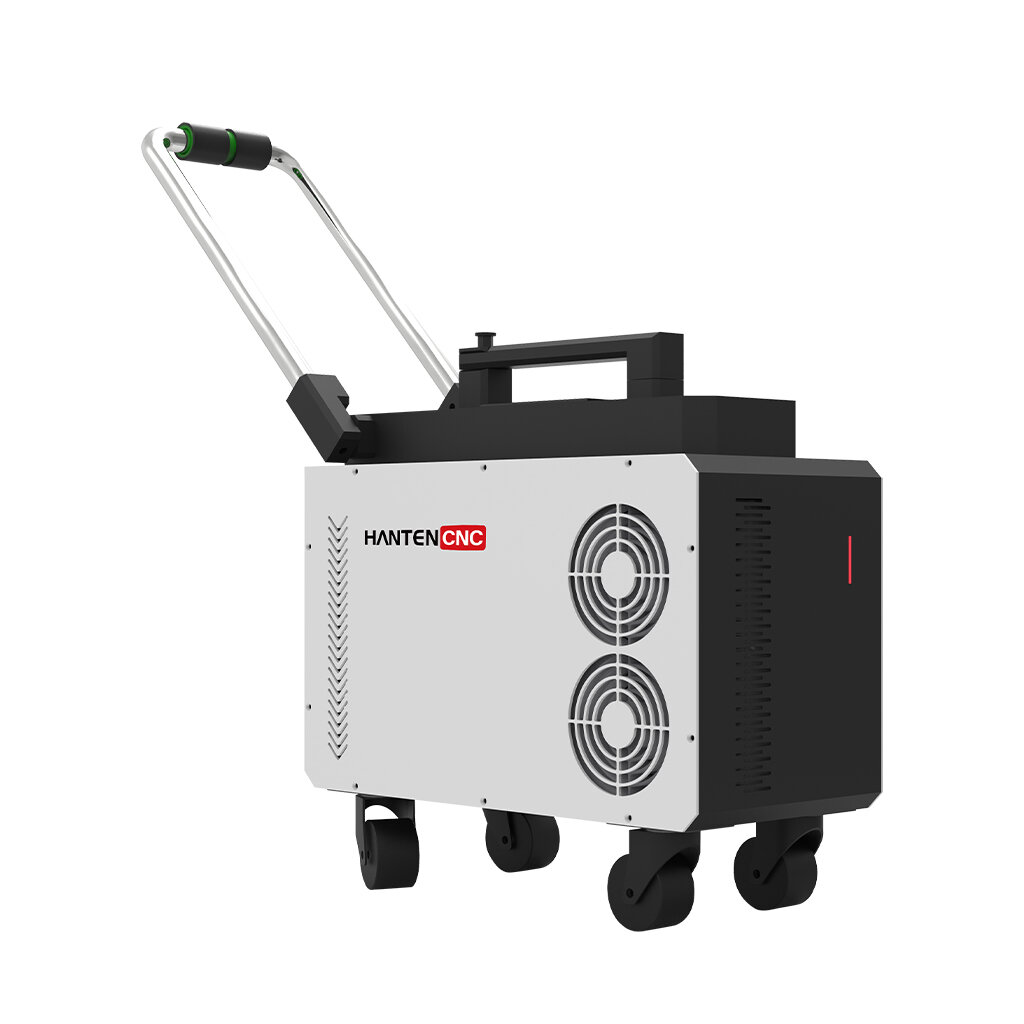
1. Is higher laser cleaning power always better?
When people buy things, in many cases they judge by first impression. So when someone first comes into contact with a laser cleaning machine or laser cleaning, they may feel that a higher-power machine must have better cleaning effect and better efficiency than a lower-power one. But in many situations, that is not really true.
A laser cleaning machine is mainly used to remove the contamination layer from the surface without damaging the base material. In other words, when choosing a machine, you should not only look at the power. You also need to confirm the working environment, parameter settings, and the material you want to clean. After all that is set, the key point is whether it can really remove rust, oxide, and other contamination on the surface.
For example, when working on molds and other precision parts, choosing a higher-power machine may improve efficiency, but it may also damage the base material surface. If the parameters are not adjusted well, it may affect the later use of the part. On the other hand, in large-area rust removal and industrial maintenance work, power that is too low may lead to poor efficiency, longer cleaning time, and higher site cost. So if someone says higher machine power is always better, that is only true under certain conditions. In other words, under the right working condition, higher power can be better.
2. What kind of work fits different power levels?
From a basic judgment point of view, we can understand laser cleaning machine power like this.
1) 100W–300W: better for fine and controllable cleaning
This range is more common in a pulse laser cleaning machine, and it is usually used for:
- mold cleaning
- light rust removal
- thin oxide layer removal
- surface cleaning of precision parts
- materials that are sensitive to heat
- wood surface cleaning
Machines in this range are not made to chase large-area removal. They are meant to finish the job with lower heat effect as much as possible. This is especially important for wood. If a higher-power machine is used, the wood surface may get burned or darkened. As the laser cleaning machine market changes, 300W machines have slowly become one of the first choices for many buyers.
2) 500W–1000W: a balance between control and efficiency
The 500W laser cleaning machine is one of the more common types on the market now. Especially in pulsed laser cleaning machines, many buyers see this kind of equipment as a preferred choice. In terms of cleaning result, application range, and machine price, this type of machine can meet the needs of many users.
Common applications include:
- thin paint removal
- general oxide cleaning
- light to medium rust removal
- jobs that need some efficiency, while still wanting to control surface heat effect
If your work is not very light fine cleaning, but also not large heavy-duty cleaning, then this range is usually a safer choice.
3) 1000W–3000W: better for large-area and heavy-duty cleaning
High-power cleaning machines are more suitable for industrial work. They clean faster, cover a larger area, save time, and can still meet the cleaning requirement. They are suitable for:
- large steel structure laser rust removal
- thick rust and heavy rust removal
- stubborn coating and thick paint removal
- maintenance of pipes, equipment housings, and ship parts
- industrial sites that require higher output in limited time
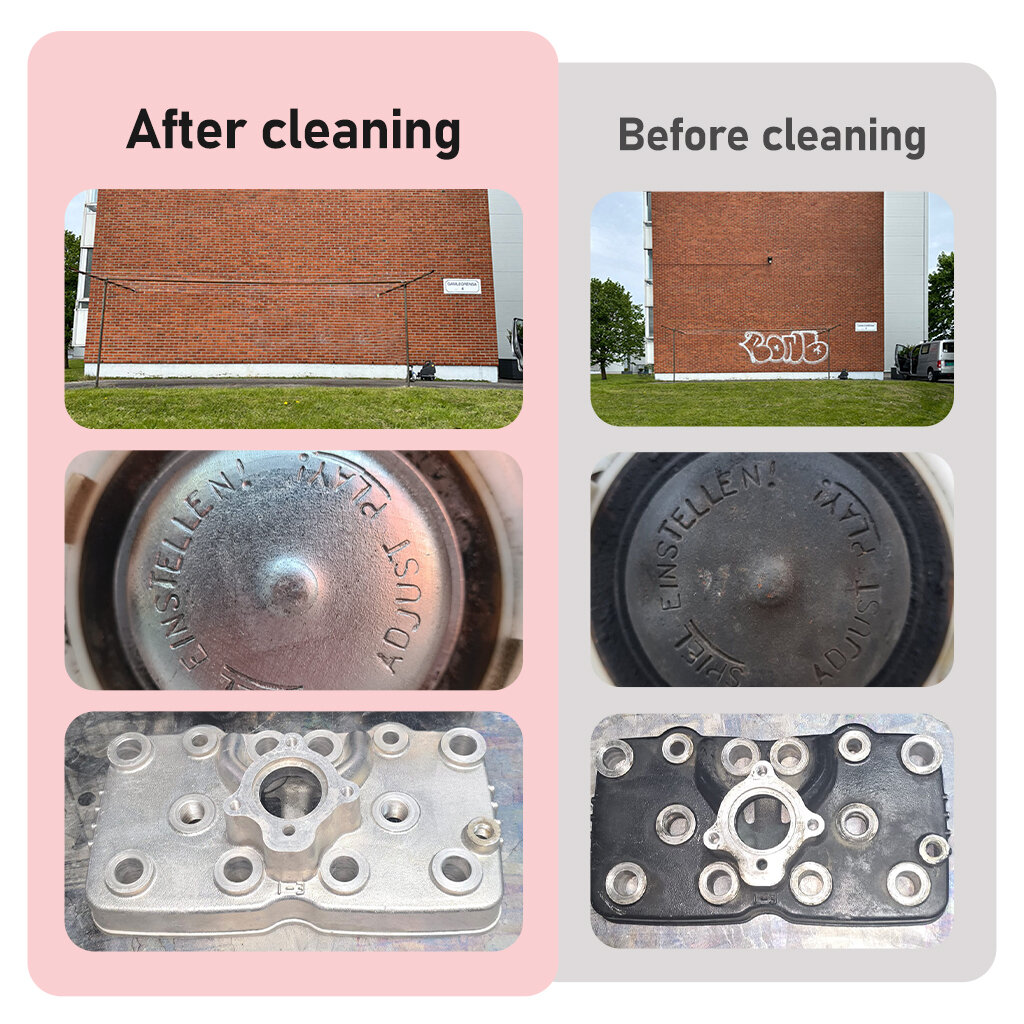
3. Why can laser cleaning power choices be so different?
Different working conditions naturally lead to different power choices. Some cleaning jobs are very clear in purpose. They just want to remove the contamination from the surface, and they do not care much about small surface damage to the material. In that case, higher-power equipment often has more advantage. On the other hand, some jobs need lower-power equipment, because the work is not only about removing contamination, but also about protecting the base material surface.
For example, cleaning the contamination on precision metal parts is only the first step. After that, there may still be welding, coating, or other work. In this kind of application, the requirement for the surface is much higher: whether the base material gets overheated after cleaning, whether the surface roughness changes, and whether the next process will be affected. These later requirements show that this kind of work is not suitable for blindly choosing high-power equipment. Even if the parameters are adjusted well, some problems may still appear during cleaning.
So even though the power difference looks very large, the real reason behind it is the difference in application goals. It is not about which machine is more advanced. It is about which machine is more suitable for your job.
4. How do you choose between pulsed laser and continuous laser?
If you only look at the names, the difference already seems clear. Continuous laser cleaning works in a continuous way, while pulsed laser cleaning works in pulses.
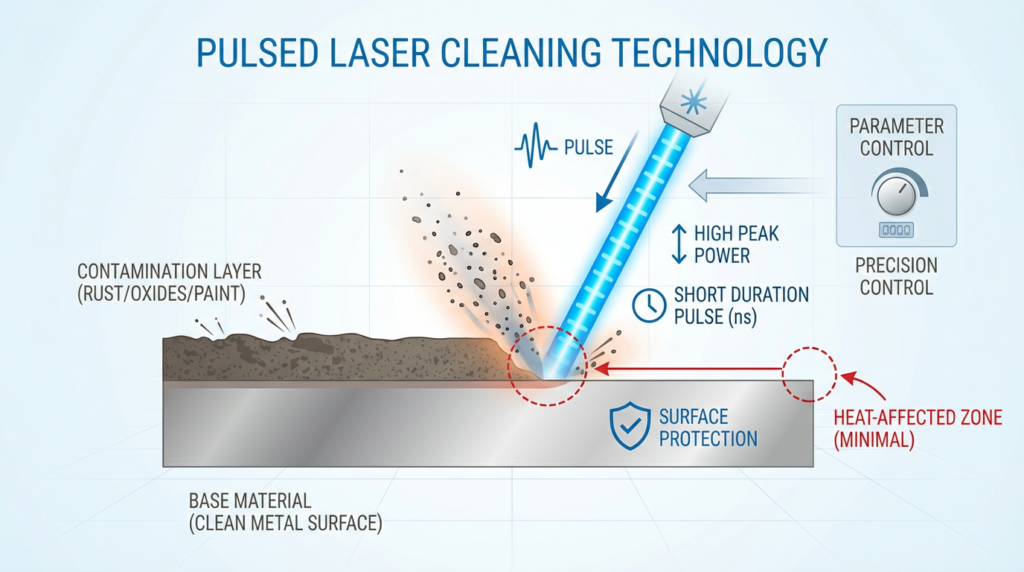
1) Pulsed laser: better for fine surfaces and heat-sensitive work
Pulsed laser cleaning mainly releases energy in a short time, so it is easier to keep the heat effect in a smaller range. Because of that, it is often used for:
- mold cleaning
- precision hardware parts
- thin oxide layer removal
- local paint removal
- workpieces that need better base material protection
If you care more about removing only the contamination layer and not disturbing the base material too much, then a pulse laser cleaning machine is often a better choice.
2) Continuous laser: better for large-area work and higher efficiency
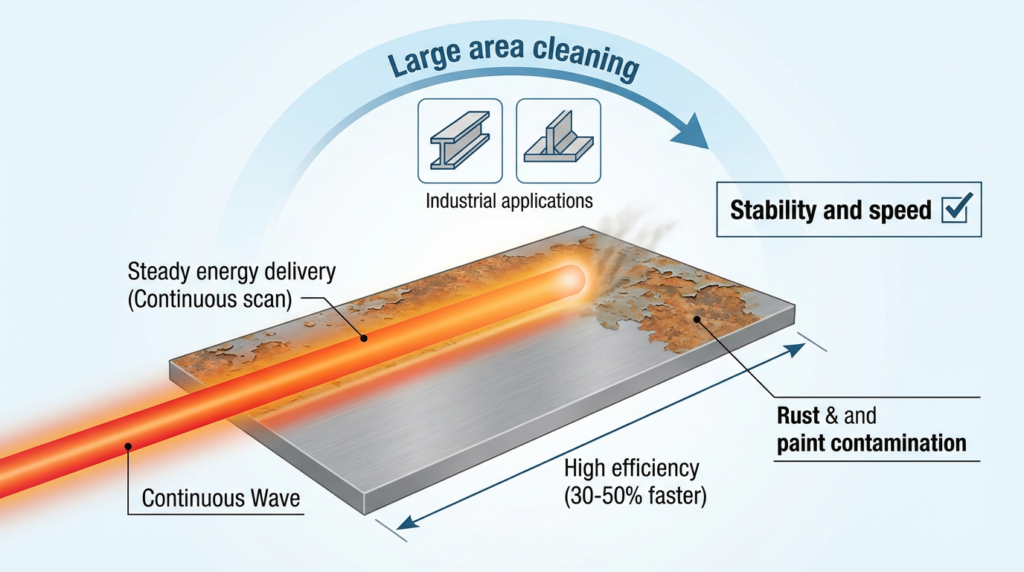
Continuous laser is more about steady output. In large-area work, heavy contamination, and efficiency-focused applications, it often has more advantage. Common uses include:
- rust removal on steel structures
- thick rust and heavy rust treatment
- large-area paint removal
- surface pre-treatment in industrial maintenance
- jobs with higher output and faster working rhythm
If your main concern is processing area and total output, then high-power continuous laser is usually a more practical choice.
3) A quick way to judge
It can be understood in one sentence:
If you want better surface control, look at pulsed laser first.
If you want higher cleaning efficiency on large areas, look at continuous laser first.
Of course, in the end, you still need to judge it together with the material, contamination thickness, and cleaning goal. You should not make the final decision only by looking at the machine type.
5. How should you choose power for different applications?
If you want to choose the right machine power, it is better to judge it by application. That way is closer to real demand.
1) Metal rust removal: first look at rust thickness, then look at area
Rust removal is one of the most common uses of a laser cleaning machine, and it is also how many users first come into contact with laser cleaning. Because of that, many buyers simply call a laser cleaning machine a laser rust removal machine or laser rust remover.
If it is only light rust, floating rust, or surface oxide, then in many cases a low- or medium-power pulsed machine can clean it quite well, and it is also easier to control the surface condition.
But if it is thick rust, large steel structures, or surface treatment on heavy machinery, then the value of high-power equipment becomes much more obvious. At that point, the question is no longer “Can it remove it?” but “How fast can it finish the job?”
So when choosing a laser rust removal machine, the first two questions should be:
- How thick is the rust?
- How large is the cleaning area, and how much efficiency do you need?
2) Paint removal: in many cases it needs more process control than rust removal
When many people do laser paint removal, the first thing they look at is also power. But in real work, paint removal often depends more on process control than rust removal, especially in the following cases:
- aluminum alloy surfaces
- thin sheet parts
- surfaces that should not show clear color change
- cases where the base layer needs to be kept as much as possible
- structures with multiple coating layers
If it is a thin paint layer, or if there is a higher requirement for surface quality after cleaning, then a medium-power pulsed system is usually a safer choice.
If it is thick paint or large industrial parts, then a higher-power laser paint removal machine may be needed.
So when choosing a laser for paint removal, you should not only ask, “How many watts?” You should also ask, “How much heat can the base material take?”
3) Mold cleaning: control matters more than brute force
Mold cleaning usually does not chase extreme power first. The reason is simple. The main goal here is not to sweep the surface as fast as possible, but to make sure that:
- the base material is not damaged
- the size is not affected
- there are no clear heat marks
- corners and fine details stay stable
Because of that, mold cleaning is usually more suitable for pulsed solutions, and in many cases there is no need to keep pushing for higher power. In this kind of work, whether the process window is stable is often more important than a higher number on the parameter sheet.
4) Pre-weld cleaning and oxide removal: consistency matters more than speed
Before welding, surface cleaning often needs to remove oxide, light rust, or surface dirt. This kind of work has a higher demand for cleaning consistency because it directly affects welding quality later.
If the treatment area is fixed and the part size is the same, then medium power is often enough. Too much power may not give a better result. Instead, it may make parameter control more sensitive.
5) Precision parts and electronic components: protect the base material first
For precision electronic parts or metal parts with higher surface requirements, the surface condition after cleaning is often more important than cleaning speed. In this kind of application, pulsed laser usually shows more advantage, and the power choice is also more about control, not just pushing the number higher.
6. How should you understand 300W, 500W, 1000W, 2000W, and 3000W?
| Power | Main Characteristics | More Suitable For | Things to Keep in Mind |
| 300W | A relatively balanced power level, with a good mix of precision, efficiency, and application range | Light to medium cleaning work, thin oxide removal, light rust cleaning, and jobs with some surface quality requirements | Not ideal for large-area thick rust or heavy contamination |
| 500W | Higher efficiency than lower-power machines while still keeping a certain level of surface control | Some paint removal work, more complex metal surface treatment, and light to medium industrial cleaning | Even with better efficiency, it still needs to match the material and heat sensitivity |
| 1000W | Clearly moves into industrial efficiency-focused applications and works better on larger areas | Steel surface rust removal, thick contamination removal, and larger workpieces | Not always the best choice for fine parts or heat-sensitive materials |
| 2000W | Better for large-area work, high production rhythm, and longer continuous cleaning tasks | Thick rust, heavy rust, large metal structures, and industrial site cleaning | It focuses more on efficiency, but parameter control and job matching become more important too |
| 3000W | More suitable for heavy-duty work and high-output industrial tasks | Large steel structures, thick coatings, and large-area industrial maintenance | Not suitable for every surface; fine parts and heat-sensitive materials need more caution |
7. Cleaning efficiency is affected by more than power
When judging cleaning efficiency, you cannot rely on power alone. There are many factors that affect the final result.
| Factor | What It Means | How It Affects Cleaning |
| Scan Speed | Faster scanning usually means a larger area can be covered in less time, but only if the energy density is still enough | Fast scanning does not always mean good cleaning. The result still has to meet the target |
| Spot Size and Scan Width | A wider scan width can cover more surface area, but the effective energy on each area will also change | It has to match the power and speed, or the cleaning quality may drop |
| Contamination Thickness | Thin rust, thick rust, a thin paint layer, and multiple thick paint layers are very different conditions | Thicker contamination usually needs more time and better parameter matching |
| Base Material | Steel, aluminum, stainless steel, copper alloy, and other materials react differently to laser cleaning | The same power level may give very different results on different materials |
| Final Process Requirement | Some parts need welding, coating, bonding, or precision assembly after cleaning | The higher the later process requirement, the less you can focus on speed alone; surface condition and consistency also matter |
In simple words, higher power may give the machine a higher upper limit, but whether it can really clean in an efficient way still depends on whether the parameters and the job target match well.
8. What kind of work fits portable and handheld laser cleaning machines?
Portable and handheld cleaning machines are newer styles that many laser cleaning machine makers have developed in recent years. The purpose is to solve some problems of traditional machines, such as being bulky, hard to move, and more troublesome to operate. The main difference between these two types is really the use scene. Their internal structure and core parts are mostly similar.
Usually, portable and handheld machines are more suitable for:
- on-site maintenance
- workpieces that are hard to move
- scattered work points
- local cleaning
- small and medium repair work
Their main advantage is flexibility, not simply higher output. So when judging this kind of equipment, you should not only look at power. You should also think about continuous working stability, cooling ability, operating comfort, site working rhythm, and how much cleaning consistency is needed. Some projects are indeed suitable for handheld operation, but if the job has high rhythm, large area, and long continuous working time, handheld equipment may not be the best answer for efficiency.
9. How do you know if a laser cleaning machine is right for you?
If you want to know which machine is right for you, the first step is to make your own needs clear. Then judge the equipment based on those needs.
1) What material is your workpiece made of?
Different materials have different tolerance to heat effect. That decides whether you can go straight to higher power or not.
2) What are you trying to remove?
Rust, paint, oxide, oil stains, glue residue — different kinds of contamination need different energy input and process windows.
3) How large is the cleaning area?
Local repair and large-area continuous work have completely different requirements for machine power and working method.
4) Do you care more about speed or surface quality?
If you care more about surface condition and consistency, then blindly chasing high power may not be right.
If you care more about output and cleaning rhythm, then higher-power solutions may make more sense.
5) Will there be another process after cleaning?
If the part still needs welding, coating, bonding, or assembly after cleaning, then the surface condition after cleaning is often more important than cleaning speed.
If you answer these questions first and then look at machine power, your judgment will usually become more accurate.
10. Common questions
Does laser rust removal always need high power?
Not always. For light rust, local rust, or parts with higher surface requirements, low- or medium-power pulsed equipment can also give good results. Only when the rust is thick, the area is large, and efficiency matters a lot does high-power equipment show a clearer advantage.
Does paint removal always need higher power than rust removal?
Not always. Paint removal often cares more about heat control, especially for aluminum, thin sheet parts, or surfaces with higher appearance requirements. In some cases, a medium-power pulsed solution is actually a better fit.
Conclusion
When choosing laser cleaning equipment, the easiest mistake is to treat power as the only standard. In fact, what really decides the cleaning result is the match between the workpiece material, contamination type, cleaning area, surface requirement, and later process.
If your work is more about fine control, heat-sensitive parts, and better surface quality, then pulsed solutions are usually worth looking at first.
If your work is more about large-area rust removal, thick paint removal, and industrial efficiency, then higher-power solutions usually have more advantage.
Mircari Quotes And Sayings
 How to Focus on Studying for Successful Admission
 Top 5 Tension Fabric Display Suppliers in Singapore
 Can video games replace traditional teaching methods?
 Alexander Ostrovskiy: 10 Glute Exercises You’re Not Doing (But Should Be)
 How to Make Your Cornhole Games More Fun with Themed Bags
 Common Car Wreck Injuries
 How A San Antonio Injury Lawyer Can Help You After An Accident
 Blue Wall Paint Trends and Tips: Choosing the Perfect Wall Paint