From Naples Airport to Positano, the advantages of planning a private transfer in advance
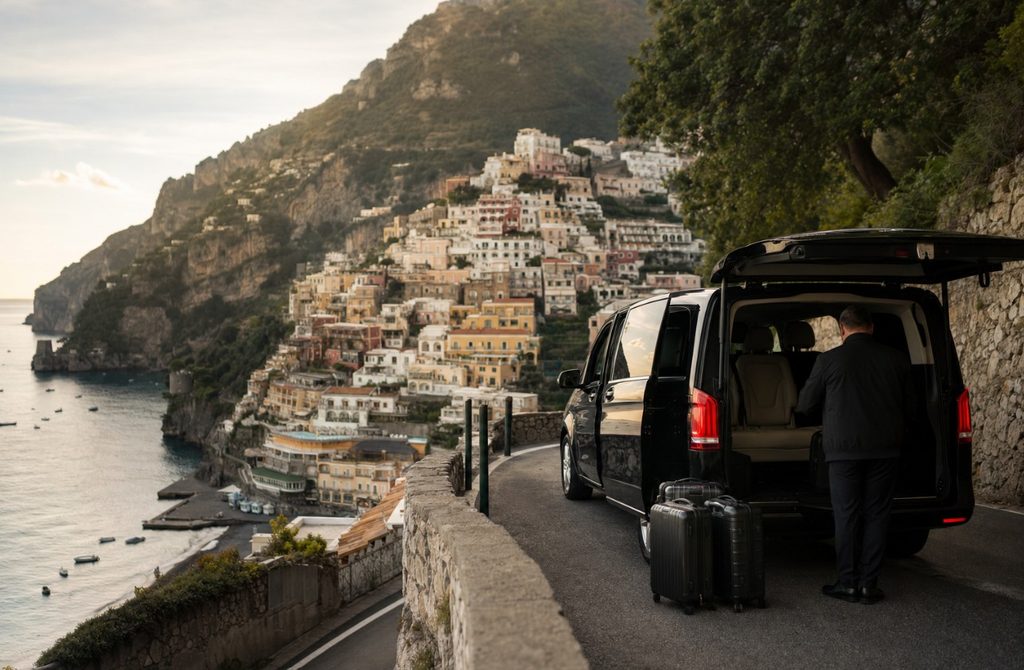
What is the least complicated way to travel from Naples International Airport to Positano? A private car arranged before you fly: one vehicle, one driver, one drop-off at the closest point local traffic rules allow. Roughly 60 km separate the two, and published operator estimates for the drive range from about 1 hour 15 minutes to 2 hours. The distance is short. The variables are not.
Those variables stack up quickly on a single arrival day: a motorway section followed by a coastal road subject to traffic ordinances, a town where vehicles physically cannot reach many front doors, and an airport that does not operate around the clock. Planning the transfer weeks ahead is less a comfort decision than a way of removing choices from the moment you are least equipped to make them — tired, at four in the afternoon, with three suitcases and no local data plan.
A short decision summary before the detail:
- A private car fits arrivals with heavy or bulky luggage, small children, a party that would otherwise split across vehicles, a fixed commitment later that day, or a first visit to the coast.
- Scheduled services deserve consideration if you travel light, your schedule is elastic, and the journey itself is part of the holiday rather than an obstacle to it.
- Whichever you choose, the deciding factors are the same four: declared duration and route, capacity in passengers and bags, what the price includes, and the conditions attached to extras, waiting and cancellation.
What a private transfer means on this route
Definitions first, because the word transfer is used loosely online and the differences are operational rather than cosmetic.
A private transfer is a point-to-point ride reserved for your party alone, with a stated capacity in passengers and luggage and a stated set of inclusions. It is measured by the journey rather than by commentary along the way; whether any guiding, stop or extra service forms part of it depends entirely on the offer you book, and it is worth asking rather than assuming. On this particular route it is also, by necessity, a door-to-nearest-permitted-point service rather than a literal door-to-door one, because parts of Positano cannot be reached by car at all.
Inclusions are the first thing to read, and the level of disclosure varies widely between published offers. One example of the detail worth looking for: the Naples-to-Positano service listed by Sorrentolimo is quoted from €140, with a stated duration of approximately 1 hour and 20 minutes in regular traffic conditions, and declares an English-speaking driver, taxes and tolls, fuel and parking fees as included. The same page publishes vehicle capacities — a Mercedes VAN, Viano or V Class type for up to 8 passengers and up to 12 bags, an E Class type for up to 2 passengers and 2 bags — and a maximum of 16 people for the service overall. Those figures describe that provider’s offer, not a market standard. The point is the specification itself: a quote with numbers attached is a quote you can check.
Note the word from in front of any starting price. It describes one configuration. What you pay depends on the vehicle, the number of passengers, the time of day and any extras you add.
Duration and distance: plan against the longer figure
On a map, the airport and Positano look a comfortable hour apart. The map is not wrong; it is incomplete.
Published estimates for the identical journey diverge by roughly three quarters of an hour. Distances given by transfer operators sit between 60 and 61 km. Durations quoted for that same stretch include approximately 1 hour 20 minutes in regular traffic, 1 hour 15 to 1 hour 30, and 1.5 to 2 hours. The route commonly described runs on the A3 motorway and then the SS163 Amalfi Coast road — two very different driving environments, which is a large part of why the estimates disagree.
That spread is the honest answer rather than a hedge. Where credible figures for the same 60 km differ by 45 minutes, the variability is real, and a schedule should absorb it instead of assuming it away. Build your plan on the upper end of the range in high season, and treat any tighter figure as a pleasant surprise.
The multi-leg alternative is perfectly viable and worth understanding on its own terms. Reaching Positano without a private car involves chaining together separate services, each with its own timetable and its own point of failure — and failures compound, because a departing boat is indifferent to why the previous leg ran late. With three large cases in July, that chain becomes a workout rather than a transfer. It is a legitimate choice; it is simply a different product from a single confirmed vehicle.
Timing: your landing slot is not your pickup time
The most common planning error on this route is treating the scheduled landing time as the moment the wheels start rolling towards the coast. Between touchdown and the terminal exit sit taxiing, deplaning, border control on some itineraries, and the baggage belt. Build that gap in deliberately, and agree with your provider how the meeting will work if it stretches.
Two operational details published by the airport itself are worth knowing before you even choose a flight.
Opening hours come first. Naples Airport states that it is open from 03:30 to 22:30, and that it closes from 22:30 to 03:30 for security reasons in accordance with ENAC, except in the case of exceptional flight delays. If your inbound flight is scheduled to land close to that boundary, a delay stops being a minor inconvenience: it places you in a terminal that is shutting for the night. That is precisely the arrival profile where an arrangement made weeks earlier does the most work.
Baggage services come second. The GLS and Comebag store at the airport provides shipping, storage and baggage handling, sits outside the terminal about 150 metres from the main entrance, and opens every day including holidays from 08:00 to 20:00. Useful if you want to send a bulky case ahead or leave excess luggage behind for a few days — but only within those hours, which is exactly the sort of constraint that belongs in a plan rather than in an improvisation at the kerb.
From there, buffer logic is straightforward. If something is waiting at the other end — a dinner reservation, a property with a fixed check-in cut-off, a boat the following morning — work backwards from the upper end of the published duration range and add terminal exit time on top. And if any part of your onward plan depends on a scheduled service, check that operator’s timetable for your specific arrival hour rather than assuming coverage.
The SS163 ordinance that can reshape an afternoon
Here is the constraint most arrival guides skip, and it has nothing to do with comfort.
Publicly available summaries of ANAS Ordinance No. 340/2019 describe an alternate licence-plate transit restriction on the SS163 Amalfitana between 10:00 and 18:00: on odd calendar dates, circulation permitted for plates ending in an odd digit; on even dates, plates ending in an even digit. One such summary records that, as of mid-June 2022, the obligation was triggered along a stretch of roughly 55 km of the SS163 covering municipalities including Positano, Praiano, Furore, Conca dei Marini, Amalfi, Atrani, Ravello, Minori, Maiori, Cetara and Vietri sul Mare, and notes that the SP2 Valico di Chiunzi — both the Ravello and Maiori branches — and the SR366 Agerolina fall outside the measure. A 2026 guide to the same ordinance describes it as applying on the SS163 from Vietri sul Mare to Positano, with motorbikes and scooters exempt.
Rules and activation periods change; check current ANAS and municipal notices for your own dates. These are second-hand summaries with dates attached, not a live status report, and nothing in them should be read as confirmation that the restriction is in force during your trip.
The practical weight of this falls mainly on travellers weighing a rental car. The plate handed over at the desk can determine whether a stretch of coast road is open to you at a given hour on a given date — a variable outside your control, and an awkward one to discover mid-journey. A chauffeured booking takes that particular lottery out of your hands, though the underlying obligation to comply with current rules does not disappear; it simply sits with the operator rather than with you.
Positano’s last few hundred metres
Positano is built on a slope, and its street layout includes restricted-traffic zones and pedestrian lanes. Vehicles cannot reach the entrance of every property, and no service can change that. Published transfer information for the route reflects this openly: drop-off is made at the closest allowed point, and hotels can arrange porter service for bags where needed.
This is geography and traffic regulation rather than a shortcoming of any provider. It is, however, something to establish before arrival instead of discovering on a staircase in July. Three questions do most of the work: where is the closest point a vehicle may legally stop for my address, how far and how steep is the walk from there, and can the property assist with luggage. Send your exact address, the entrance name and the property’s phone number when you book, and confirm again the day before.
Capacity: count bags, not people
Capacity failures are the most avoidable problem on this route, and they tend to be a communication problem rather than a vehicle problem. Two adults with a large hard case each, a cabin bag each, a folded stroller and a set of golf clubs do not fit the same car as two adults travelling light — which is precisely why the more transparent transfer pages state capacity in passengers and bags rather than in headcount alone.
Families should settle child seats at the booking stage. On the Naples–Positano page referenced earlier, infant seats are listed as available on request, and en-route stops such as Pompeii, Herculaneum, Mount Vesuvius or a wine tasting are selectable at the second step of the booking form. If you land in the morning and cannot check in until mid-afternoon, breaking the drive is a sensible use of otherwise dead hours — but that request belongs in the reservation, not in a conversation at the terminal exit. Whether other providers offer comparable options, and on what terms, is a question to put to them directly.
For parties above eight, the choice lies between splitting across vehicles or booking a coordinated multi-vehicle service; the page cited above states a maximum of 16 people. Splitting works. Coordinating separate, independently arranged arrivals at a restricted drop-off point in Positano is where it turns fragile.
Cost clarity: start from the official number
You do not have to guess the order of magnitude, because the airport publishes an official taxi tariff sheet. In the 2024 edition, the predetermined one-way extra-urban taxi fare from Naples Airport to Positano is listed at €145.00 per vehicle, excluding motorway tolls and a possible €5.00 minivan supplement; the equivalent fare to Sorrento is listed at €125.00 per vehicle on the same terms. Those are 2024 figures for a regulated fare and should be re-checked against the current sheet — but they give you a benchmark independent of any commercial offer.
Against that benchmark, compare inclusions rather than headline numbers, and convert everything into the same unit before you judge. Pricing structures differ: some published transfer offers state a figure per vehicle, others quote a starting price per person for a stated party size, and some publish separate day and night tariffs. Ask whether tolls and parking sit inside the fare or are added afterwards, what is billed as an extra, and at what point the quoted price stops being the price you pay. Cancellation terms vary too — published deadlines on this route range from a day before departure to a week — so read the specific offer rather than assuming a common practice.
Quick answers
How long does it take? Published distances sit at roughly 60 to 61 km. One provider states approximately 1 hour and 20 minutes in regular traffic conditions; another describes the same drive as taking about 1.5 to 2 hours. Both figures refer to specific offers. Use the longer one as your planning assumption in peak season.
How much does it cost? Two reference points you can verify yourself: the airport’s 2024 official taxi tariff sheet lists €145.00 per vehicle to Positano, excluding tolls and a possible minivan supplement; as a private transfer example, the page cited earlier publishes the service from €140 with taxes and tolls, fuel and parking stated as included. Your own figure depends on vehicle, timing, party size and extras.
Three arrival scenarios, three different priorities
Morning landing, same-day check-in. The risk here is dead time, not delay. If your property cannot take you before mid-afternoon, an en-route stop is a better use of three hours than a café outside a locked door — and where such stops are offered, they are arranged within the booking rather than requested on the day.
Afternoon landing. The risk is the coastal road at its busiest, potentially overlapping with the 10:00–18:00 window described in the alternate-plate ordinance summaries, if that measure applies to your dates. Communicate the drop-off point precisely and plan for the upper end of the duration range.
Evening landing. The risk is the tail of the day, at an airport that states it closes at 22:30. This is where an arrangement made in advance earns its keep — and where it is worth asking the provider directly what their waiting-time terms are and whether they monitor inbound flights, rather than assuming either.
When a private transfer is not the obvious answer
It is not the right call for every traveller. With one cabin bag, an elastic schedule and an appetite for the journey itself, the multi-leg route can form part of the holiday rather than an obstacle to it — and the approach to Positano from the water is something no car can offer. Check current timetables and fares with the relevant operators for your dates before you build it into a tight itinerary as a fixed link.
A hybrid approach frequently makes sense: a private car on arrival day, when you are carrying everything and know the least about the place; scheduled services later in the trip, once you have your bearings and your bags are unpacked. Availability of app-based ride hailing varies by location, date and hour, so treat it as an unknown rather than a fallback. The two options you can pin down before you fly are the regulated airport taxi tariff and a private hire booking confirmed in writing.
Six questions to settle before you confirm
- Exact meeting point at the terminal, and which phone numbers each side holds.
- Passenger count and bag count, matched against the vehicle’s declared capacity.
- Drop-off specifics: nearest permitted stopping point for your address, walk distance, luggage assistance.
- Inclusions in writing: taxes, tolls, fuel, parking, any night rate, and anything billed as an extra.
- Delay handling: waiting-time terms, whether inbound flights are monitored, and how to reach the provider on landing.
- Change and cancellation conditions, with the deadline expressed in a time zone you can read at a glance.
None of this is glamorous, and none of it takes more than twenty minutes at a desk. That is rather the point. On a coast this steep, the planning that pays off is the unspectacular kind, done early, from a sofa a long way from the SS163.
Mircari Quotes And Sayings
 KMSpico Download: How It works, How to download and Why you should be careful
 Weekend Gaming with Friends? Here’s the Setup You Need
 The Timeless Appeal of Automatic Watches: Why They Still Matter Today
 AOMEI Partition Assistant Review: Simplify Disk Management for Windows 11
 Why Settle for Boring? Building Features That Make Life More Fun
 Best Indoor Seeds: High-Yield Indoor Strains for Every Grower
 Modern Loneliness and the Rise of Paid Companionship Services
 The Comfort Routine People Are Turning To This Year