How AI App Builders Are Rewriting Software Development in 2026
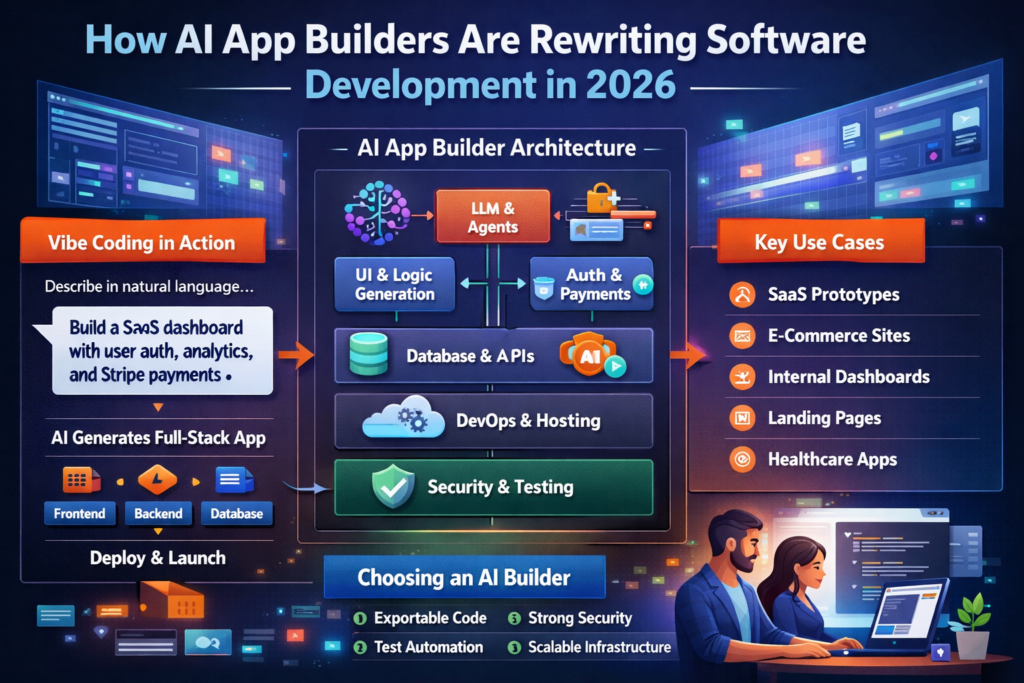
Artificial intelligence has already changed how we search, summarize, and create images — in 2026 it’s also changing how software is built. AI-first platforms that turn plain-English product requirements into production-ready web apps are moving from novelty to everyday tools. Companies like Fabricate let a product idea go from description → working prototype → deployed app with a mix of natural-language prompting, automated scaffolding, and integrated infrastructure. This article explains the rise of “vibe coding,” the technical architecture behind modern AI app builder, real-world use cases (SaaS, e-commerce, dashboards), and a practical rubric for choosing the right AI website/app builder.
Why 2026 feels different: the shift from typing code to directing systems
The last two years have seen an acceleration in tools that combine large language models (LLMs), agent workflows, and managed hosting. The result: people who can describe workflows in natural language — product managers, domain experts, or founders — can now produce working applications without hand-writing every file. That practice has a name: “vibe coding,” a shorthand for prompting AI to generate functional code and iterating by testing and guiding the model rather than manually implementing low-level details. As these AI-generated applications become more complex, integrating top test management solutions into the development process helps ensure code quality, collaboration, and reliable software delivery. Advocates argue this lowers the barrier to entry; critics warn it can obscure maintainability and security trade-offs.
What an AI app builder does (end-to-end)
A modern AI app builder combines multiple capabilities into a single flow:
- Natural-language to spec — The platform converts a description (e.g., “build a subscription SaaS dashboard with Stripe, user auth, and analytics”) into a structured spec and wireframes.
- Code generation & scaffolding — LLMs generate frontend (React/TSX, CSS), backend (Node/Express, serverless functions), and infra-as-code (deployment, DB schema).
- Agentic orchestration — Task-specific agents run tests, create migrations, wire APIs, and auto-fix simple runtime errors.
- Managed services — Hosted databases, authentication, storage, and CI/CD are provisioned automatically.
- One-click deploy & preview — The app is deployed to staging or production with monitoring and rollback options.
These building blocks allow teams to focus on product design and validation instead of repetitive plumbing. Fabricate’s product messaging emphasizes short prototype times and full-stack delivery from prompts — a concrete example of this end-to-end shift.
Technical architecture — a breakdown
A typical architecture for an AI app builder in 2026 looks like this:
- Frontend layer (generated): React/TypeScript components, routing, state management (hooks or state machines), and auto-generated UI forms based on inferred data models.
- Application logic (generated + human-augmented): Serverless functions or containerized microservices for business logic, generated endpoints, and validation layers.
- Persistence layer: Automatic schema generation (Postgres, Supabase, or proprietary DB), migrations, and ORM models created from inferred data attributes.
- Auth & payments: Built-in connectors for OAuth, JWT, and payment processors (Stripe/PayPal) that the generator wires into the login/checkout flows.
- DevOps layer: IaC templates (Terraform or CloudFormation), automated CI pipelines, container image builds, and managed hosting with autoscaling and observability (logs, traces, SLOs).
- LLM/agent orchestration: A controller that breaks the high-level request into tasks (generate UI, wire DB, create routes), manages model calls (including retrieval-augmented generation for project-specific context), and runs verification tests.
- Safety & governance: Security scanners, static analysis, license checks on generated packages, and human-in-the-loop approval gates.
The crucial idea: AI replaces a portion of the human labor curve (the repetitive, boilerplate, and connector work) while humans remain responsible for architecture, design choices, and final QA. Industry strategy papers and trend reports in early 2026 predict engineers will shift from implementers to orchestrators of agents and systems.
Vibe coding, agentic engineering, and where humans fit
“Vibe coding” (or the newer term some experts prefer, “agentic engineering”) is not about removing humans — it’s about changing which human skills matter. Instead of spending time writing CRUD boilerplate, engineers spend time on:
- Defining precise product intent and acceptance criteria.
- Designing secure, scalable architecture that generated code must conform to.
- Reviewing and hardening AI outputs (security, performance, legal compliance).
- Creating tests and monitoring to catch regressions the generator missed.
That said, accepting AI output without sufficient review increases risk: latent bugs, brittle integrations, and insecure defaults can slip into production. Thoughtful adoption pairs rapid prototyping with strict QA, observability, and a rollback plan. Recent industry commentary shows prominent engineers and researchers debating the terminology and responsibilities as the community defines best practices.
Use cases that benefit most
- SaaS MVPs & prototypes — Fastest wins: validating product ideas by launching a working MVP in hours rather than weeks. Fabricate and similar tools explicitly pitch short prototype times.
- E-commerce stores — Product catalog generation, checkout flows, and basic inventory management scaffolding are boilerplate tasks that AI can scaffold quickly; businesses can then focus on UX and marketing.
- Internal dashboards & tools — Non-engineering teams (sales, ops, HR) can describe reporting needs and get a secure internal tool with database connectors and role-based access controls. This use case is booming because it removes internal developer backlogs.
- Landing pages & marketing sites — Simple content-driven sites with forms, integrations, and A/B-ready blocks are trivial for AI builders, so marketing teams can iterate fast.
- Verticalized domain apps — Healthcare documentation assistants, legal intake forms, and HR onboarding flows — especially when domain experts drive specification — can be produced faster, but require strict compliance checks. See examples of domain experts rapidly shipping specialized apps in recent hackathons.
Evaluation criteria: Choosing an AI website/app builder
When selecting a platform, weigh these dimensions:
- Output transparency & exportability
- Can you export a clean codebase? If the generator locks you in, future migration is risky. Prefer platforms that provide downloadable, well-documented code.
- Can you export a clean codebase? If the generator locks you in, future migration is risky. Prefer platforms that provide downloadable, well-documented code.
- Security & compliance tooling
- Built-in static analysis, dependency vulnerability scanning, and configurable auth are must-haves for production apps.
- Built-in static analysis, dependency vulnerability scanning, and configurable auth are must-haves for production apps.
- Testing & verifiability
- Does the platform auto-generate unit/integration tests or at least provide a test harness? Agentic fixes are great, but automated tests are the guardrail.
- Does the platform auto-generate unit/integration tests or at least provide a test harness? Agentic fixes are great, but automated tests are the guardrail.
- Infrastructure control
- Do you get fine-grained control over deployments, CI/CD, and infra templates? For scale, that control matters.
- Do you get fine-grained control over deployments, CI/CD, and infra templates? For scale, that control matters.
- Integration ecosystem
- Connectors for payments, email providers, analytics, and enterprise SSO reduce integration friction.
- Connectors for payments, email providers, analytics, and enterprise SSO reduce integration friction.
- Team workflows & collaboration
- Does it enable multiple contributors, role-based access, PR-style reviews, and audit logs?
- Does it enable multiple contributors, role-based access, PR-style reviews, and audit logs?
- Cost & licensing model
- Understand per-seat/compute pricing and any licensing on generated code or bundled third-party libraries.
- Understand per-seat/compute pricing and any licensing on generated code or bundled third-party libraries.
- Community & support
- Active community, templates, and good documentation shorten the learning curve.
- Active community, templates, and good documentation shorten the learning curve.
Use these criteria to evaluate options such as Fabricate and other AI builders; community rankings and comparison pages published in 2026 help but always validate with a small pilot.
Quick win checklist for adopting an AI app builder safely
- Start with prototypes and non-critical tooling (landing pages, internal dashboards).
- Require exported code and a migration plan before putting customer data on a generated app.
- Add automated tests and a security review as part of the CI pipeline.
- Limit generated dependencies to well-known, audited packages.
- Keep humans in charge of secrets, payment flows, and authorization logic.
Final thoughts — are traditional workflows really gone?
Not yet. What’s changing is the shape of work: engineers focus more on architecture, data, security, and orchestration; product teams can rapidly validate ideas; domain experts can ship useful tools themselves. AI app builders like Fabricate are catalysts — they lower the cost of experimentation and compress time-to-feedback — but responsible companies will treat generated code as a starting point, not a finished product. If you combine rapid AI-driven prototyping with rigorous testing, observability, and clear exportability, you get the best of both worlds: speed and safety.
Mircari Quotes And Sayings
 Blue Wall Paint Trends and Tips: Choosing the Perfect Wall Paint
 How A San Antonio Injury Lawyer Can Help You After An Accident
 Common Car Wreck Injuries
 How to Make Your Cornhole Games More Fun with Themed Bags
 Alexander Ostrovskiy: 10 Glute Exercises You’re Not Doing (But Should Be)
 Can video games replace traditional teaching methods?
 Top 5 Tension Fabric Display Suppliers in Singapore
 How to Focus on Studying for Successful Admission